
Taking stock
The Greek historian Diogenes, who lived around 200AD, said of markets that they are “places set apart where men may deceive each other”. He would surely have had a similarly jaded view of what is, in modern times, probably the most important market of them all: the “stock market”. This article looks simplistically at what stock markets are, how they function and how they came about.
Simply put, a “stock market” is a public market for the trading of company shares at an agreed price. The stock market is one of the most important sources for companies to raise money. By allowing businesses to be publicly traded, companies can raise additional capital for expansion by selling shares of ownership of the company to the public. Potential buyers and sellers in the stock market range from small individual investors to large corporations, pension funds and governments. The shares (also called “stocks”) sought to be traded are “listed” on a “stock exchange”. A stock exchange is a private organisation which specialises in the business of bringing buyers and sellers of shares together.
Market forces
The purpose of a stock exchange is to facilitate the exchange of shares and other financial instruments between buyers and sellers, effectively providing a marketplace. Exchanges also act as clearing-houses for each transaction, meaning that they collect and deliver the shares,
Market forces
The purpose of a stock exchange is to facilitate the exchange of shares and other financial instruments between buyers and sellers, effectively providing a marketplace. Exchanges also act as clearing-houses for each transaction, meaning that they collect and deliver the shares,
and guarantee payment to the seller of a share. This eliminates the risk to an individual buyer or seller that the other party could default on the transaction.
At a stock exchange, share prices rise and fall depending, largely, on market forces. Supply and demand in stock markets is driven by various factors which, as in all free markets, affect the price of stocks. Investors wanting to buy and sell shares must do so through a stockbroker, who pays to own a seat on the exchange. Companies with shares traded on an exchange are said to be “listed” and they must meet specific criteria, which varies across exchanges. Most stock exchanges began as floor exchanges, where traders made deals verbally face-to-face. Most stock markets, including our own JSE Ltd, now operate electronically.
Fair exchange
In a stock exchange, trades are based on an auction market model where a potential buyer bids a specific price for a share and a potential seller asks a specific price for the share. When the bid and ask prices

match, a sale takes place on a first- come first-served basis if there are multiple bidders or askers at a given price.
History
The history of stock exchanges can be traced to 12th century France, when the first brokers are believed to have developed, trading in debt and government securities. Unofficial share markets existed across Europe through the 1600s, where brokers would meet in or outside coffee houses to make trades. The Amsterdam Stock Exchange, created in 1602, became the first official stock exchange when it began trading shares of the Dutch East India Company. These were the first company shares ever issued.
By the early 1700’s there were fully operational stock exchanges in France and England, and America followed in the later part of the century. The early days of stock exchanges experienced many scandals and share crashes, as there was little or no regulation and almost anyone was allowed to participate in the exchange.
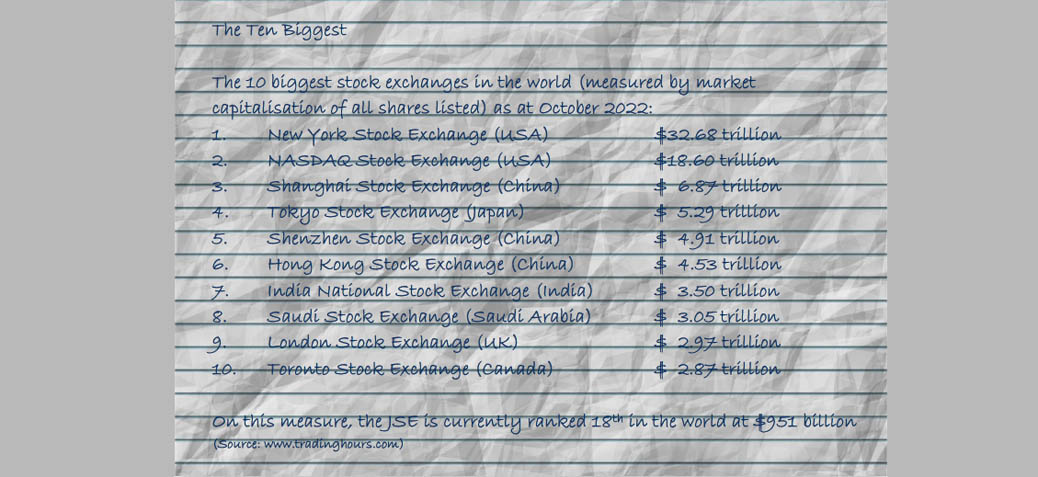
Today, stock exchanges operate around the world, and have become highly regulated institutions. Currently there are hundreds of stock exchanges operating throughout the world. Countries with bigger economies have numerous stock exchanges: the USA has large stock exchanges operating in Boston, Chigaco, Miami and at least four in New York alone, including the two largest in the
world – the famous New York Stock Ex-change and the NASDAQ (“National Association of Securities Dealers Automated Quotations”). Even relatively poorer countries have active stock exchanges: the world’s smallest stock exchange is thought to be Cameroon’s Stock Exchange which has only two listed shares. Sudan has a surprisingly large stock market: its Khartoum Stock Exchange has over fifty listed companies, but traders there must act quickly – the exchange is only open for trade for one hour a day. And keeping with the African theme, while our own JSE is the largest on the continent, it was not the first: Egypt’s stock exchange was formed in 1883, four years before the JSE, and at one point in their history the Egyptian Stock Exchange was one of the five biggest in the world. And South Africa has more than one exchange: in 2017, the Cape Town Stock Exchange was launched, originally as 4AX but subsequently rebranded as the Cape Town Stock Exchange.
The Big Apple
For sheer size and global importance, few exchanges compare with the New York Stock Exchange, situated at 11 Wall Street in lower Manhattan. It is the largest stock exchange in the world in terms of the US dollar value of its listed companies’ shares. As at August 2022, the combined worth of all domestic New York Stock Exchange listed companies was US$ 32.68 trillion (US$ 32,680,000,000,000). The origin of the NYSE can be traced to 1792, when 24 stockbrokers met under a buttonwood tree
in Wall Street and signed the “Buttonwood Agreement”. Twenty-five years later, the organisation drafted a constitution and renamed itself the “New York Stock & Exchange Board”. The first central location of the NYSE was a single room, rented in 1817 for $200 a month, located at 40 Wall Street.
Today, the NYSE is a popular tourist attraction and the public can watch proceedings from behind bullet-proof glass in a gallery. Whilst bullets may not be able to halt proceedings, large falls in share prices will do just that: a “circuit breaker” rule halts trading when the Dow Jones Industrial Index drops by certain predetermined percentages. The rationale behind the trading halt is to give investors a chance to cool off and re-evaluate their
Today, the NYSE is a popular tourist attraction and the public can watch proceedings from behind bullet-proof glass in a gallery. Whilst bullets may not be able to halt proceedings, large falls in share prices will do just that: a “circuit breaker” rule halts trading when the Dow Jones Industrial Index drops by certain predetermined percentages. The rationale behind the trading halt is to give investors a chance to cool off and re-evaluate their
positions in the hope of avoiding the events during the 1929 crash, when traumatised traders made their way to the most convenient open windows in the building.
A channel to wealth
Today, a stock market is a vital component of a free-market economy. It allows companies to raise money by offering shares and other financial instruments to investors, who may thus participate in the financial achievements of the companies, and make profits through capital gains, and earn income through dividends. A stock market works as a platform through which savings and investments of individuals are efficiently channeled into productive in-vestment opportunities and add to the capital formation and economic growth of a country.