
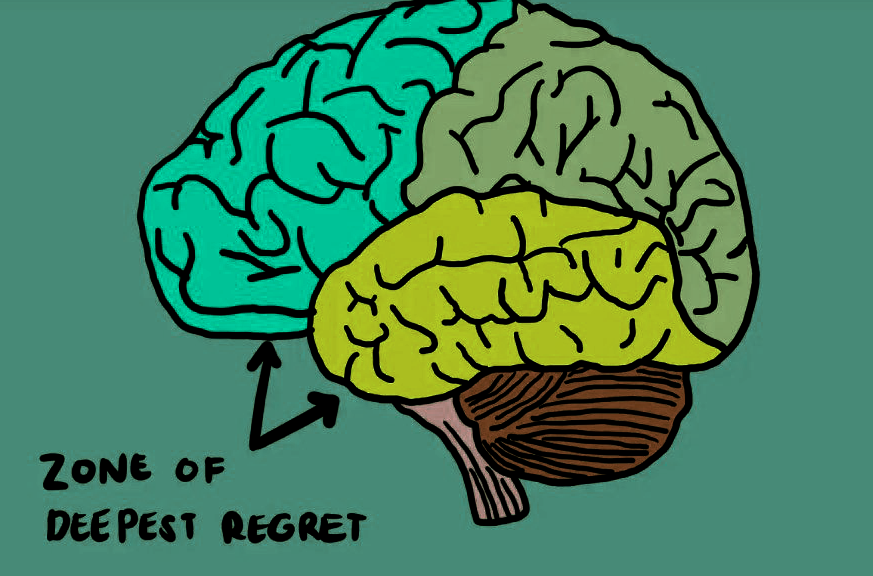
Zone Of Regret
Why it happens
Support for the emotional component of regret aversion can be found in neuroscientific studies, which suggest that anticipated regret’s powerful influence on future decisions is a function of our emotional pathways in the brain. One study associated regret aversion with increased activity in the orbitofrontal cortex and the amygdala, a connection that is believed to be highly involved in emotional processing.
Moreover, as Daniel Kahneman and Amos Tversky’s renowned prospect theory states, people are more sensitive to negative than positive events. With regret manifesting in negative emotion, we learn over time that this is an aversive outcome and seek to eschew the possibility. As with many cognitive biases, our preferences are derived from how we feel about a prospect rather than what we think about it.
Regret aversion is likely to be even stronger in decisions with significant consequences, such as health and financial decisions. While we may factor in regret when choosing between menu items at a restaurant, this regret will likely not loom as much as the potential regret of choosing the wrong house, for example. This makes regret aversion a non-trivial bias, as it can impact high-stake decisions.
Aside from its influence, the ability of the bias to help or hinder depends on the context. Regret aversion can increase positive health-related behaviours, but also result in irrational decision-making in investing.
Regret aversion is also believed to be a mechanism that we use to avoid cognitive dissonance. A theory developed by American psychologist Leon Festinger in 1957, cognitive dissonance refers to the way in which individuals strive to avoid the discomfort that arises when there are inconsistencies between their decisions and the outcomes. By trying to predict how we’ll feel about the future outcomes of our current decisions, regret aversion may help us to avoid potential cognitive dissonance.