
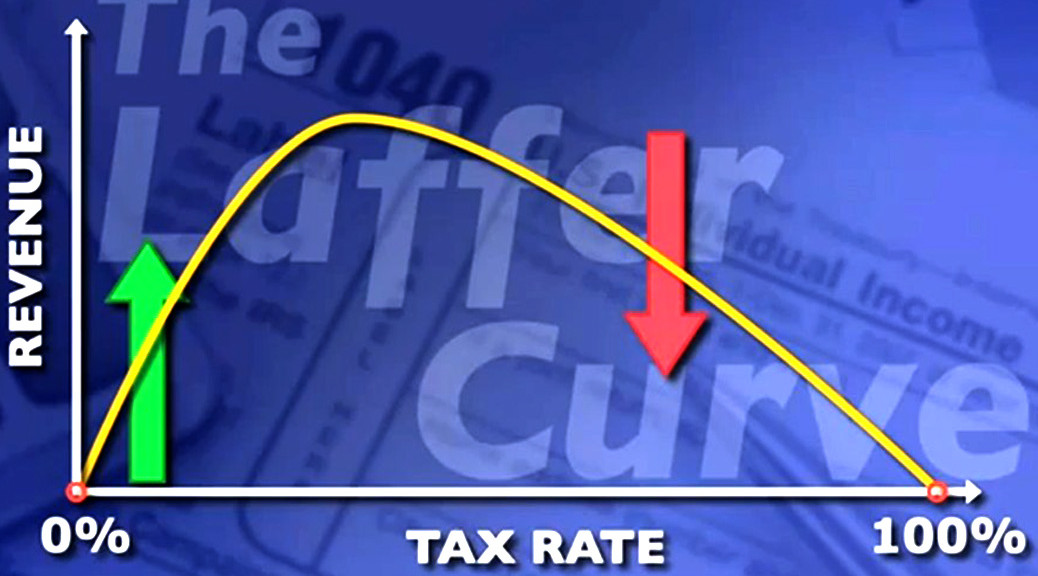

Laffer Curve:
The curve suggests that as taxes increase from low levels, tax revenue collected by the government also increases. It also shows that tax rates increasing after a certain point (T*) would cause people not to work as hard or not at all, thereby reducing tax revenue. Eventually, if tax rates reached 100% (the far right of the curve), then all people would choose not to work because everything they earned would go to the government. Governments would like to be at point T*, because it is the point at which the govern-ment collects maximum amount of tax revenue while people continue to work hard.
The curve suggests that as taxes increase from low levels, tax revenue collected by the government also increases. It also shows that tax rates increasing after a certain point (T*) would cause people not to work as hard or not at all, thereby reducing tax revenue. Eventually, if tax rates reached 100% (the far right of the curve), then all people would choose not to work because everything they earned would go to the government. Governments would like to be at point T*, because it is the point at which the govern-ment collects maximum amount of tax revenue while people continue to work hard.
The curve is named after American economist Professor Arthur Laffer. Laffer reportedly sketched it on a napkin in a meeting in 1974 with officials of President Gerald Ford’s administration to illustrate his argument against proposed tax increases. Laffer does not claim to be the inventor of the curve and notes that a similar concept is found in the writings of the 14th century Arab philosopher Ibn Khaldun .