
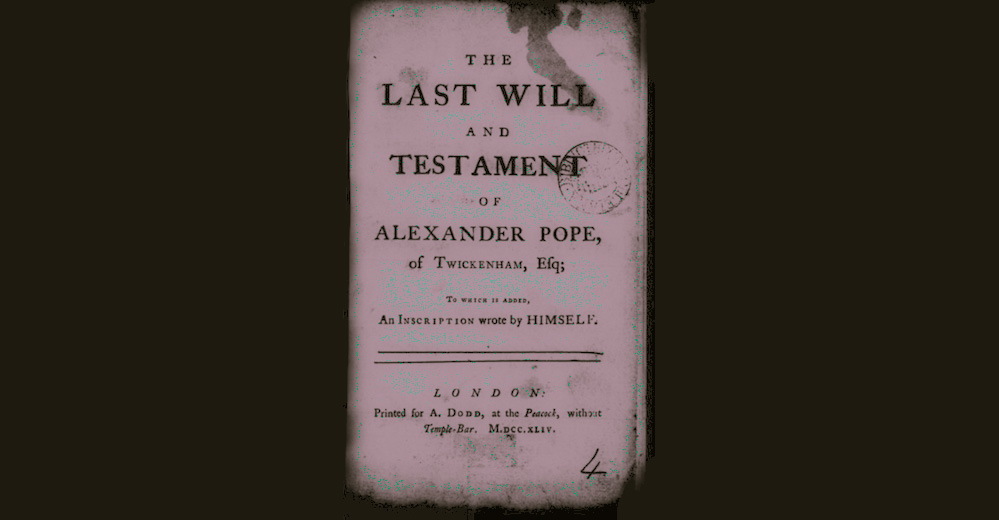
Where there isn’t a Will
The death of a family member usually leads to much emotional and financial trauma for the survivors left behind. In situations where the deceased has not left a Will or no Will can be found (called dying “intestate”), the trauma is usually exacerbated.
It’s not only ordinary people who die without Wills; some famous people who died without a Will include Abraham Lincoln, Howard Hughes, Martin Luther King Jr. and Pablo Picasso.
Even lawyers overlook key issues in their Wills: Warren Burger, the late Chief Justice of the United States Supreme Court, who died in 1995, took the trouble to handwrite a 176 page Will but he failed to give any power to his executors and made no provision for estate taxes. These apparent oversights are thought to have cost his estate thousands of dollars.
Even for those who aren’t rich and famous, the failure to leave a proper Will can have many unintended adverse financial consequences.
What is a “Last Will and Testament”?
A Will can be defined as a written document in which the maker, called the “testator” (male) or “testatrix” (female) voluntarily sets out instructions as to how their assets are to devolve following death.
Our legislation simply refers to a “Will”. So where does the “Testament” part fit in? The word “Testament” has no legal status in our law; it is thought that its use arose from old English law whereby people disposed of their land by way of “Will” and their personal assets in a separate “Testament”.
Today, one’s Will should deal with all one’s assets, both immovable and movable. For testators who have assets overseas, it could be advisable to execute Wills in the foreign jurisdictions in which the assets are situated.
A Will should also nominate an executor (the person appointed to wind-up the estate), trustees (who will look after assets in the estate on behalf of heirs) and guardians (who will take minor children into their care).
Who inherits an estate if there is no valid Will?
Our laws of intestate succession set out the ranking of close relatives who will inherit the estate of a deceased when no Will has been found.
As a rough guide, preference is given first to the deceased’s spouse and descendants. In the event of there being no surviving spouse or descendants, then the parents of the deceased rank next. Failing a parent or parents, then the deceased’s siblings have a claim. If none of these heirs exist, then more distant blood relatives are considered. Where there is a total failure of all blood relations of the deceased and there is no surviving spouse, then the estate is forfeited to the state.
Who can make a Will?
Any person aged 16 years or older, who is mentally sound and understands what he is doing can make a Will. A minor does not need a parent’s consent to make a Will.
Sometimes couples execute “joint” or “mutual” Wills. Usually these parties are married, but nothing stops any two (or even more) people, such as a parent and child, or business partners, executing such a Will.
A joint Will is interpreted as two or more separate wills, with the bequests of each person applying only to his or her own estate.
The joint Will is not an agreement as such, and either party can effect a new separate Will without the consent (or even knowledge) of the other.
Who can inherit in a Will?
Almost anyone can inherit. You can leave your worldly possessions to “natural” persons (human beings) and even entities such as companies, close corporations, intervivos trusts, charities and, for the extremely civic-minded, one can even leave your assets to the state
 It’s time to renew your will when…you get divorced
Your divorce does not automatically annul any previous Will (including a joint will with your ex-spouse). The law effectively allows divorcees a 3 month grace period from divorce to amend their Wills. If you die after this period leaving a will made during your previous marriage then this Will normally stands even if your ex-spouse is the appointed heir! This could result in your ex-spouse inheriting part of or even your entire estate, often to the detriment of a current subsequent spouse.
Unfortunately for animal lovers, one may not leave assets to a family pet. However, funds can be left to trustees with instructions that the fortunate creature be maintained according to specified standards.
There are certain people who are by law excluded from inheriting. Applying the increasingly quaint principle that “crime does not pay”, the law prohibits someone who murders a testator from inheriting from the victim’s estate and a person who conceals or forges a Will is also denied.
A person witnessing the testator’s signature of the Will, and that person’s spouse, whilst not morally in the same category as the murderer and fraudster, are likewise prohibited from inheriting. This prohibition is there to discourage fraudulent wills. However, to alleviate any unintended hardship, there is certain relief available for genuine heirs.
What freedom does one have in disposing of an estate?
The general rule is that a testator has freedom of testation and can dispose of.
their entire estate as they please.
You can therefore disinherit any person who does not meet your favour including a not-so-beloved spouse or a way-ward child (although surviving spouses and minor and needy children have the right to claim maintenance from the estate, and these claims are preferred to those of heirs).
Like all good general rules though, there are exceptions to this principle of freedom of testation: bequests must not be illegal or against public policy (such as a bequest of property to your daughter subject to a condition that she divorces your deadbeat son-in-law). Bequests that are too vague or uncertain will also not to enforced.
Your Will is, from your family’s perspective, the most important document you’ll ever sign. You leave your family much better off if you leave behind a decent (and recent) Will!