
The Midas Touch
Throughout history people have been intrigued, fascinated and obsessed with a soft yellow metal called “gold”. In ancient Egypt gold was thought to be the skin of the gods. Our modern vocabulary illustrates our preoccupation with gold: a partner with ulterior financial motives is a “gold-digger”, a compassionate person has a “heart of gold” and one hopes to find a pot of the stuff at the end of one’s rainbow.

Gold is likely to have been the first metal used by humans and has been highly sought after from the earliest history of mankind. Pure gold is as soft as putty – you can stretch an ounce of gold into a wire miles’ long; even the most primitive people were able to fashion beautiful objects out of it.
Good as gold
Gold has a combination of exceptional qualities. Firstly, it is virtually imperishable. There is a gold tooth bridge in an Egyptian museum, made more than 4000 years ago, that is still in good enough condition for a modern dentist to use today. Modern forms of money, such as paper, plastic and blips on a computer screen can be instantly altered or destroyed; gold maintains its qualities in whatever form it is shaped. Unlike other metals, virtually all the gold ever produced still exists today.
Secondly, gold is extremely scarce :only three parts out of every billion in the Earth’s crust is gold. It has been said that in order to obtain a kilogram of gold, about 140 tons of earth must be moved. Of course, some gold yields itself more
easily – alluvial gold was panned from rivers. A lucky prospector once discovered a solid 4.4 kg gold nugget in the Mojave Desert in California using a metal detector.
Finally, gold is extremely dense. A cubic metre will weigh about 19 tons; by comparison, a similar volume of lead will weigh only 11 tons.
Egoli
South Africa was the world’s largest gold producer until 2006. However, our gold production has declined from its peak in the 1970’s. SA’s remaining gold reserves are deep underground and increasingly expensive to mine – AngloGold’s Mponeng mine, south-west of Johannesburg, is currently the deepest mine in the world, going down more than 4 kms under the surface.
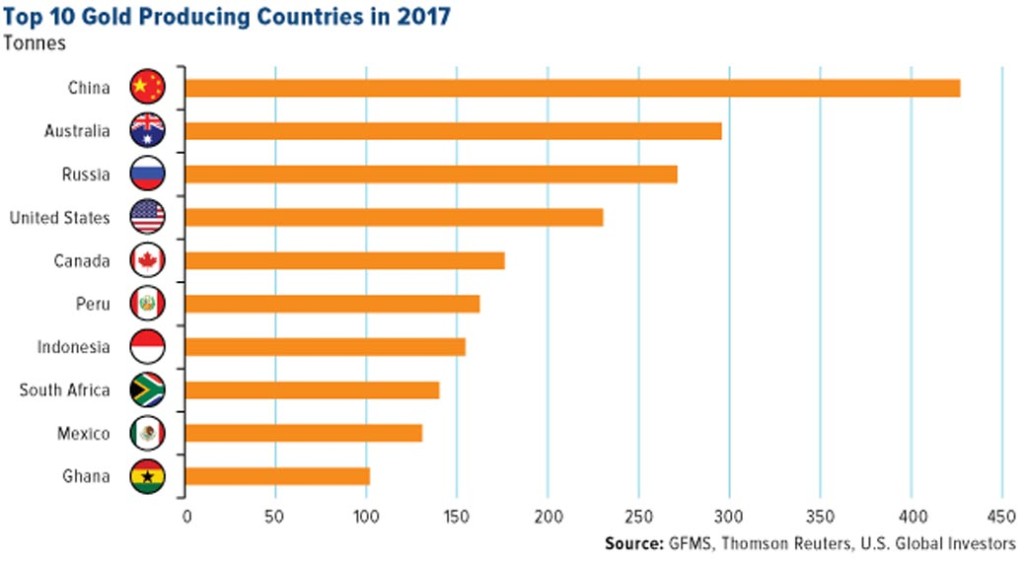
According to the GFMS Gold Survey 2018, worldwide gold production stood at 3 247 tons in 2017, with SA being the 8th largest producer, with 145 tons. China is the world’s top gold producer with 440 tons, followed by Australia and Russia.
Coining it
Pure gold is too soft for ordinary use and is typically hardened by alloying it with copper
or other base metals. Besides being used to make jewellery, gold does have some practical applications – it is a good conductor of electricity and is used in the electronics industry.
Historically, gold became the ultimate medium of monetary exchange probably due to the combination of its qualities mentioned earlier. Gold is thought to have first been fashioned into coins and used as money in about 560BC in Lydia, an ancient country situated in present day Turkey. Modern coinage is made of base metals such as iron, nickel, lead and zinc; gold has fallen out of use for this purpose. There are, however, several gold coins available to investors and collectors – our own Krugerrand is one of the most popular.
For much of the last two centuries, gold performed an even greater function in international economics – it backed the entire worlds currency flows by countries’ adherence to the gold standard. This was a system whereby the holder of a banknote could, at any time, exchange a unit of any main currency for a prescribed amount of gold. All currencies were pegged to a stated amount of gold thus fixing the values of all currencies against one another – unlike the situation today
where most currencies continuously fluctuate in value against each other. General adherence to the gold standard collapsed in the early 1970’s, following the United States’ suspension of convertibility of US dollars to gold.
Daily fix
The usual benchmark for the price of gold is known as the London Gold Fixing, a twice daily conference call meeting of representatives of some of the world’s largest banks. It is designed to fix a price for settling contracts between members of the London bullion market, but informally the Gold Fixing provides a recognised rate that is used as a benchmark for pricing gold products throughout the world.
A golden opportunity
The individual investor may wish to invest in gold for a number of reasons. Gold is seen as a preserver of wealth in that it keeps its purchasing power. Gold has traditionally increased in value during periods of expected high inflation and geopolitical turbulence. The wisest words relating to gold, however, may be the advice from a writer who said: “Don’t miss all the beautiful colours of the rainbow looking for that pot of gold.
[Please note that this article is purely for interest sake and is not intended to constitute investment advice or advice to invest in gold – please consult your financial advisor before making any investment decisions]