It’s only money honey
Easy enough for Elvis to say! South Africa’s legal system has in the past few decades progressed in leaps and bounds in attempting to ensure equality between the sexes before the law. Until the introduction of the Accrual System into our marriage law, the legal position of married women in South Africa was one which would make even the most ardent modern chauvinist blush.
The legal position prevailing in most legal jurisdictions, even as recently as the last century, can be seen from the comment by an eminent American law professor who, writing in 1917, commented that “husband and wife are one and that one is the husband”. In South Africa, prior to 1984, our law usually left a prospective bride (particularly one intending to be a full-time mother and care-giver) with a difficult choice to make between the available marital regimes.
In the absence of an antenuptial agreement, the common law position then prevailing was that which had existed for centuries: upon marriage the spouses’ estates became one (called “community of property”), over which the husband had sole control in terms of his so-called “marital power”. Our law’s wedding gift to the bride was to effectively bestow on her the legal capacity of a child. A betrothed couple could avoid this regime from applying to their union by entering into an antenuptial agreement prior to tying the knot.
The introduction of “the Accrual System”
In 1984, the Matrimonial Property Act was passed, dragging our marital law somewhat belatedly into the 20th century. For marriages in community of property, the Act abolished the husband’s “marital” power over his wife and their joint estate. A system of joint (and equal) administration over the community assets was introduced for all such marriages (even for “in community” marriages entered into prior to 1984). The Act also gave spouses who chose to marry out of community of property another option: the “Accrual System”.

The Accrual System, based on the German model, has been described as one of “deferred sharing of profits”. It automatically applies to all marriages out of community of property after 1 November 1984, unless specifically excluded by antenuptial contract. With the Accrual System, during the marriage the spouses are fully independent and there is a complete separation of property.
On dissolution of the marriage either by death or divorce, the gains made during the marriage are shared. The Accrual System thus recognises that marriage is a partnership but assets acquired before the marriage are not shared.
How does the Accrual System work?
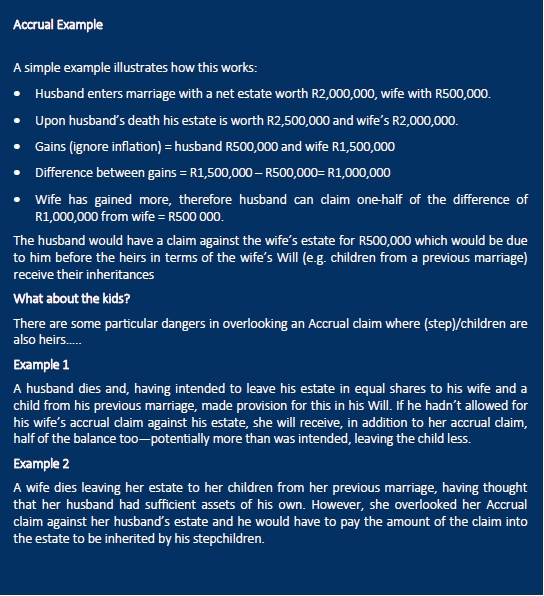
Each spouse declares a commencement value for his or her estate. On dissolution of the marriage each spouse’s estate is again valued. The spouse whose estate shows the smaller gain is given a claim against the spouse whose estate shows the greater gain, for an amount equal to one-half of the difference between the two gains or “accruals”. The commencement values are adjusted for inflation and the “dissolution” values exclude certain assets like inheritances (see Accrual ex-ample on page 5). As the example shows, it’s not always the “wealthier” spouse overall (i.e. the husband above) who has to pay the Accrual claim on dissolution!
The Accrual System effectively ensures that spouses share equally in the
While most people think of an Accrual claim in the context of a divorce, probably the most common way in which a marriage is dissolved is by death of one (or tragically both) of the spouses.
On death of a spouse, the Accrual claim is calculated and depending on their respective gains, could result in either (i) a claim being lodged by the surviving spouse against the estate of the deceased spouse (if the survivor shows the smaller gain) or alternatively, (ii) the survivor might be required to make payment into the deceased spouse’s estate (if the latter shows the smaller gain). Some antenuptial contracts provide that if the survivor has the greater accrual, then the deceased spouse’s estate’s accrual claim is forfeited.
How does the Accrual claim affect one’s testamentary planning?
The possible impact of an accrual claim upon death of either of the spouses is an important issue commonly overlooked in one’s testamentary planning. The rule is that the Accrual claim is calculated and takes effect before applying the deceased spouse’s Will.
The Accrual claim, if it is due to the surviving spouse, constitutes a claim against the deceased estate which ranks in preference behind that of other creditors but ahead of heirs.
In other words, the Accrual claim due to a surviving spouse must be paid before any other heirs such as children, parents and other can inherit. Where married couples leave their entire estates to one another in
their Wills, the effect of the Accrual claim is academic — whatever the result of the calculation, the deceased spouse’s estate ends up in the hands of the survivor. Planning for the Accrual claim By properly planning for one’s death, one can ensure that the effects of an accrual claim are dealt with — an antenuptial contract and Will can ensure there are no unintended problems, and a life assurance policy can ensure that there is enough cash available to meet any possible Accrual claim. We all hope that love is forever but it doesn’t hurt to be prepared if it doesn’t.