Beyond the grave
Most people are aware of the importance of having a will. A will ensures your wishes are known and followed and that the assets you spent a lifetime accumulating are distributed as you intended. But a Will can also be used to ensure you take advantage of certain tax saving opportunities which are available to a taxpayer on his or her death. This article looks at two strategies which one can incorporate into a Will which will result in tax savings on and after death.

Cancellation on debts / loan accounts owing to deceased
One often finds the situation where during the course of their lifetime, a person has loaned money to family members, often children, or to a trust established to acquire assets separately from the lender’s estate. The transfer of funds from the planner to his or her children or trust, to purchase for example a property or a business, is often structured by way of “friendly” loan rather than a donation because donations attract donations tax at 20% (except for the first R100 000 per tax year which is exempt). The loan is often made interest-free and is repayable on demand by the planner at an unspecified
future date.
Once the loan account is raised, it could
later be waived or written off by the planner. But the tax implications of doing so
could be severe – the write-off will be treated as a donation, attracting the donations tax mentioned above, but it is
also deemed a capital gains tax event in the hands of the debtor, triggering a capital gains tax (“CGT”) obligation. Thus the opportunity to waive or write-off debts is
fairly limited while the planner is alive. However, on death the situation is different. If the planner dies and in his or her Will, the debt is waived, this is not considered a donation and furthermore the write-off of a debt in a Will is specifically excluded from being a CGT event in the hands of the surviving debtor. In the case where the debtor is one’s trust, the ability to do away with the loan account on death is particularly relevant since the recent tax amendments which levy donations tax on loans made to the trust on an interest free or low interest basis.
In drafting the stipulation in his or her Will waiving the debt, the creditor should be careful to ensure that a unintended estate duty obligation does not result – every estate is given a R3.5 million exemption from estate duty, and if the write-off exceeds that amount, estate duty will result on the balance.
Formation of a testamentary “special trust”
One often encounters a situation where an estate planner wishes to provide for the on-going protection of vulnerable family members, such as young or financially inexperienced children and further descend-

ants, after the death of the planner. In these situations, provision is often made in the Will of the planner for a trust to be established into which the planner’s assets will pass on death, and in terms of which trusted persons (“trustees”) are appointed to administer the trust and make ongoing distributions to the stipulated family members. This type of trust is known as a “testamentary trust”. The Will usually provides for the trust to be discretionary in nature i.e. there are no guaranteed stipulated amounts that must be paid to each family member, but the decision as to who to pay and how much is rather left to the discretion of the trustees.
One of the tax benefits of such a testamentary trust, which doesn’t apply to a trust set up while the planner is alive (called an “inter vivos trust”) is that if a minor child or children,
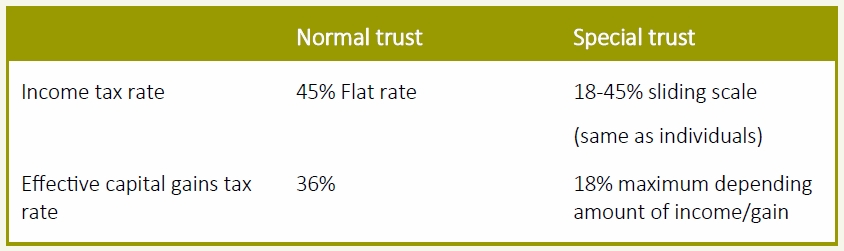
for example the planner’s young grandchildren, are stipulated as beneficiaries to whom benefits may be payable, then the testamentary trust falls under the definition of a “special trust” for the purposes of income tax and capital gains tax, for so long as the trust has a beneficiary under the age of 18 years. Tax rates applicable to special trusts are far less onerous than those applying to other trusts, as can be seen by the table below (latest 2017/8 tax rates):
The testamentary trust can thus provide all the traditional elements of protection for beneficiaries and experienced administrative oversight, but in addition can provide a more tax efficient accumulation of wealth when compared to the inter vivos trust alternative.