
Tax-free savings account – tfsa
-courtesy of Old Mutual

PART OF GOOD FINANCIAL PLANNING
Primarily aimed at the mass market as a means to encourage a saving ethos, tax-free savings products can also benefit high net worth individuals. Low to middle-income investors may find it challenging to contribute the maximum of R30 000 a year to a tax-free savings product. However, for high networth individuals (who already have more tax planning options), the new tax-free savings accounts provide an attractive option to assist with structuring their overall tax within their financial portfolios. These investors may also be able to afford to invest R120 000 on behalf of four family members, with yet another option to structure their tax affairs efficiently.
There is no time limit and contributions can be made until the end of the tax year. However, the earlier you invest, the more you will benefit from being exposed to the markets.
OLD MUTUAL WEALTH TAX-FREE SAVINGS ACCOUNT
Old Mutual Wealth will be launching a tax-free savings account in the second half of the year. It will closely mirror the current Old Mutual Wealth offering. Clients will be able to choose from a selected list of funds that incorporates our strategy and target range and is geared to cater for unique client goals and needs in a manner that is as tax efficient as possible.
Within the Old Mutual Group, the Old Mutual Invest Tax-Free Plan, Old Mutual Unit Trusts and 22seven offer tax-free savings accounts.
KEY FEATURES OF TAX-FREE SAVINGS ACCOUNTS
Key features of the new tax-free savings accounts (TFSA) include:
CONTRIBUTIONS
• Contributions are limited to R30 000 per tax year
• Lifetime contributions are limited to R500 000
Any amounts withdrawn from the account cannot be replaced.
Example: when a client contributes R30 000 for five years and then withdraws R50 000, the remaining lifetime contributions will be R350 000, not R400 000.
TAX
No tax up to the limits
• Contributions to a TFSA are from after-tax money
• Free from tax. No income tax, Capital Gains Tax or Dividend Withholding Tax
Taxed at a flat rate of 40% above the limits
Example: When an investor contributes R50 000 in a given tax year, the first R30 000 will be tax-free. The other R20 000 will be taxed at 40%,
which means the investor will be liable for tax of R8 000.
INVESTMENT LIMITATIONS
Certain restrictions on underlying investments
The following investments will not be allowed:
• Any funds that levy performance fees
• Funds that offer capital guarantees
• Direct share portfolios
• Products with contractual periodic contribution obligations (such as insurance contracts)
TAX ON DIFFERENT INVESTMENT CHOICES
Investments should not be seen in isolation, but rather as part of a holistic financial plan that provides clients with appropriate investments to meet their unique financial and lifestyle goals. Similarly, a tax-free savings account should be seen as part of the entire investment landscape and not in isolation.
In the table below, we highlight the various types of investments and different tax statuses. This should form part of effective tax planning for clients depending on their individual circumstances.

APPROPRIATE USE OF A TFSA
We can now decide on the most appropriate use of the TFSA in a personal financial planning context. The following characteristics of the TFSA are key:
TFSA over the long term
The tax benefits of a TFSA could be substantial over time from the compounding of tax savings. Because of the lifetime limit placed on contributions, investing for short periods or withdrawing is not optimal. A tax-free investment should ideally be used for longer-term savings.
Retirement Annuities versus TFSAs
This is a question that is open for debate. Retirement savings vehicles should, however, still be preferred over a TFSA for the following reasons:
1. Retirement vehicles will most likely deliver high levels of retirement income because of the pre-tax nature of contributions.
Consider the examples in the table below:

The table indicates the savings that could go to a retirement vehicle that will leave the investor with the same amount of net disposable income after contributing R30 000 to a TFSA. It is clear that the additional contribution to the retirement vehicle and therefore the higher capital balance would offset the tax payable on the income from the retirement vehicle. The tax-free commutation amount which can be taken at retirement as well as the secondary and tertiary income tax rebates will enhance this even further.
2. Retirement vehicles provide protection against poor decisions
There is a growing body of research indicating that lack of preservation is the major culprit for the low level of retirement savings in South Africa.
To this end, legislators will most likely force preservation in the future. The accessibility to savings in a TFSA therefore means that it should not be considered an appropriate vehicle for retirement savings, as investors may be tempted to access this capital to the detriment of their future retirement income.
3. Interest component of return is low
Consider a cash investment in a taxable unit trust against a TFSA. As long as the interest earned is below the annual exemption, the tax positions in both vehicles are identical. In the case of a TFSA, a portion of the lifetime limit would have been used – reducing the tax savings available to the client. Cash-heavy investments are also usually shorter term and should therefore not be housed in a TFSA as discussed previously.
The appropriate use of a TFSA can therefore be summarised either by looking at a specific goal or from a total portfolio construction point of view.
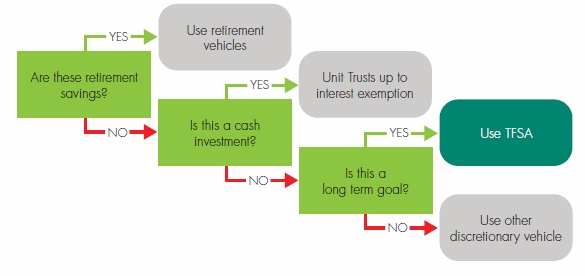
USE OF A TFSA FOR A SPECIFIC GOAL
When considering whether to use a TFSA for a specific goal, the following process can be used:
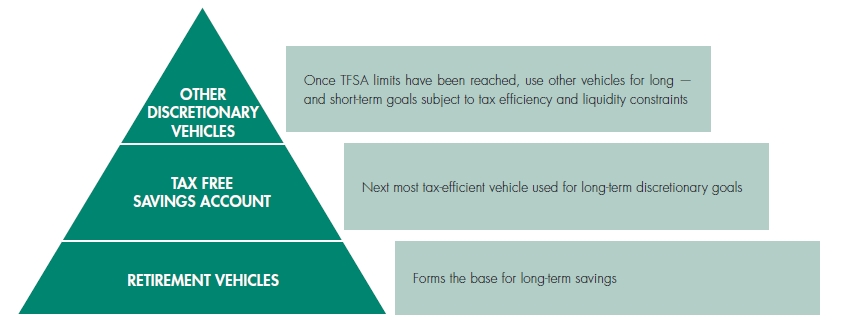
TFSA IN CONTEXT OF TOTAL PORTFOLIO
If multiple goals are being considered or the analysis is being done in the context of the client’s total portfolio, the follow structure is recommended:
CONCLUSION
The introduction of tax-free savings accounts in South Africa is significant as it enables investors to receive tax-free returns on their discretionary investments.
Because of the annual and lifetime limits, the TFSA is not likely to form a significant portion of most high income or high net asset value client’s portfolios.
It is, however, a valuable additional investment vehicle subject to it being incorporated correctly in a clients financial plan.
Retirement vehicles should still be the first port of call for long-term savings aimed at providing income in the future.